 For parents · ages 3 to 7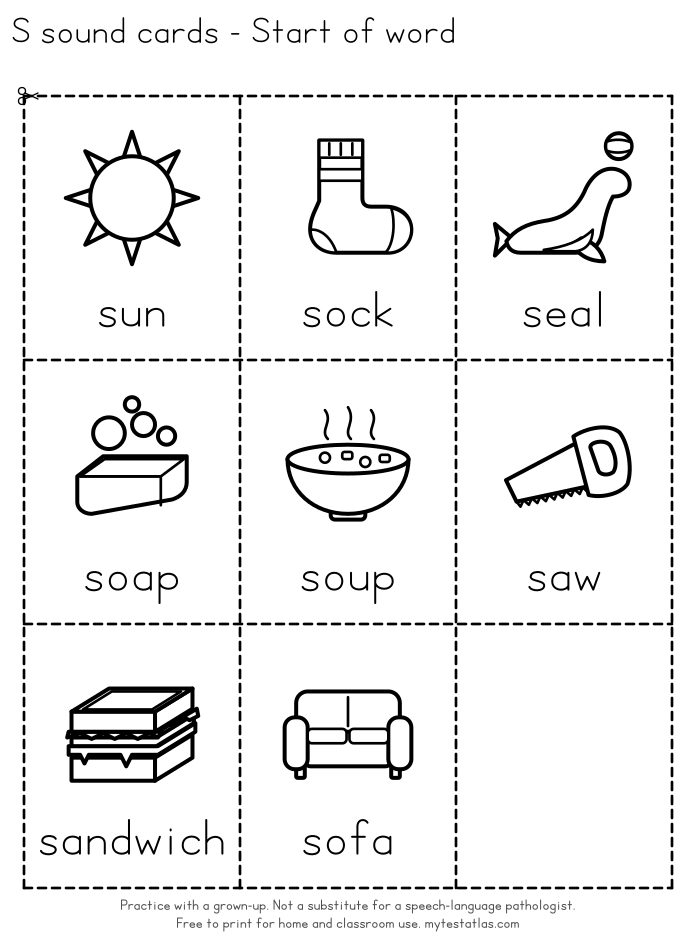
When to ask for a speech evaluation
Many sounds are still developing until age 6 or 7: R, L, S and “th” are among the last. Consider an evaluation by a speech-language pathologist (SLP) if:
- your child still says S with the tongue between the teeth after age 5;
- your child’s S sounds slushy or wet, with air escaping at the sides, at any age;
- strangers understand little of what your child says after age 4;
- the same word comes out differently each time;
- your child avoids talking or seems frustrated or teased;
- your child has lost words or sounds they used to say;
- you have any concern about hearing, or there are frequent ear infections.
At any age, also ask for an evaluation if:
- your child stutters: repeats sounds or words, stretches them out, or gets stuck;
- your child says vowels wrongly (for example “bout” for “boat”), especially if the same word also comes out differently each time;
- your child’s voice is often hoarse, or their speech sounds very nasal;
- your child understands or uses fewer words than other children their age.
In the US, evaluations can be free. From age 3, your public school district can evaluate your child for free, even before kindergarten, under the federal “Child Find” rule. Before age 3, contact your state’s Early Intervention program. Your child’s doctor can also refer you, and ASHA’s ProFind directory lists certified SLPs.
An accent or dialect is not a speech problem.
What’s typical by age
Children learn speech sounds over several years. The table shows the age range in which 9 out of 10 children in the United States say each sound correctly (Crowe & McLeod, 2020, 15 studies of 18,907 children). Many children say a sound much earlier; these are not deadlines.
| Age | Sounds 9 in 10 children say by the end of this year |
|---|---|
| 2 to 3 years | p, b, m, n, h, w, d |
| 3 to 4 years | k, g, f, t, “ng” (sing), y (yes) |
| 4 to 5 years | v, j (jump), s, “ch” (chair), l, “sh” (shoe), z |
| 5 to 6 years | r, “th” as in this, “zh” as in measure |
| 6 to 7 years | “th” as in think |
S is usually in place by 5. A lisp with the tongue between the teeth is common until about 4½. A slushy S, with air escaping at the sides, is not part of typical development at any age.
Being understood by strangers takes time too: at 4, a typical child is understood by an unfamiliar listener about half of the time, and at 5 about three quarters of the time (Hustad et al., 2021).
S word lists by position
Start of word
- sun
- sock
- seal
- soap
- soup
- saw
- sandwich
- sofa
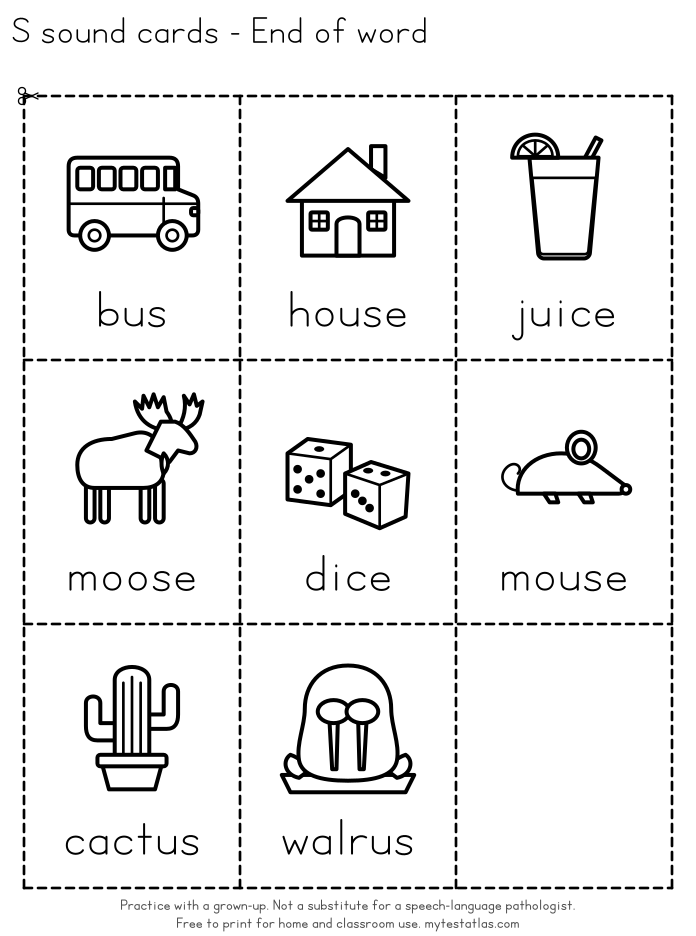
End of word
- bus
- house
- juice
- moose
- dice
- mouse
- cactus
- walrus
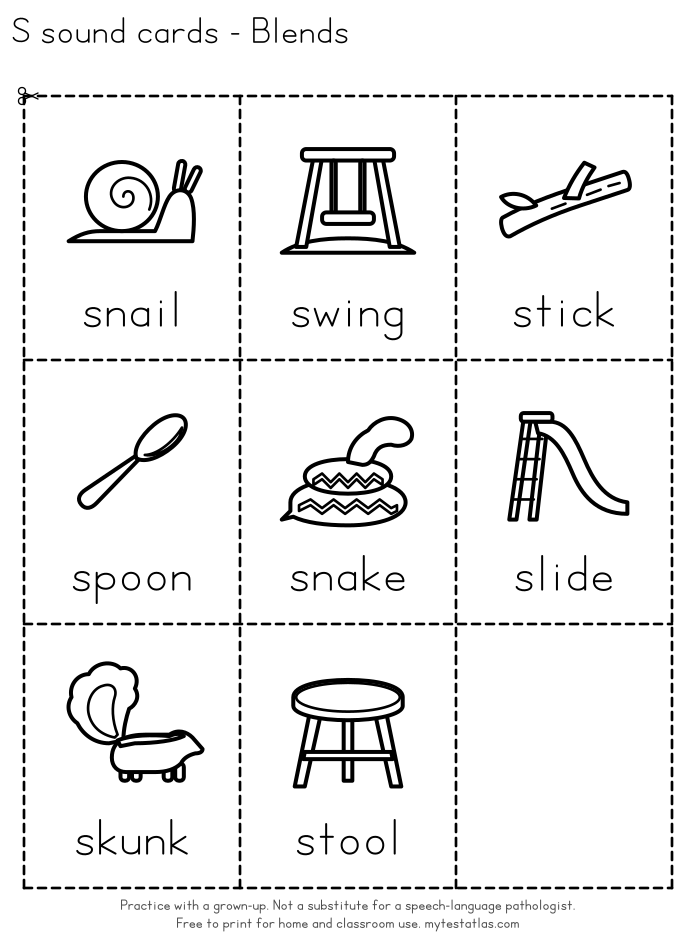
Blends
- snail
- swing
- stick
- spoon
- snake
- slide
- skunk
- stool
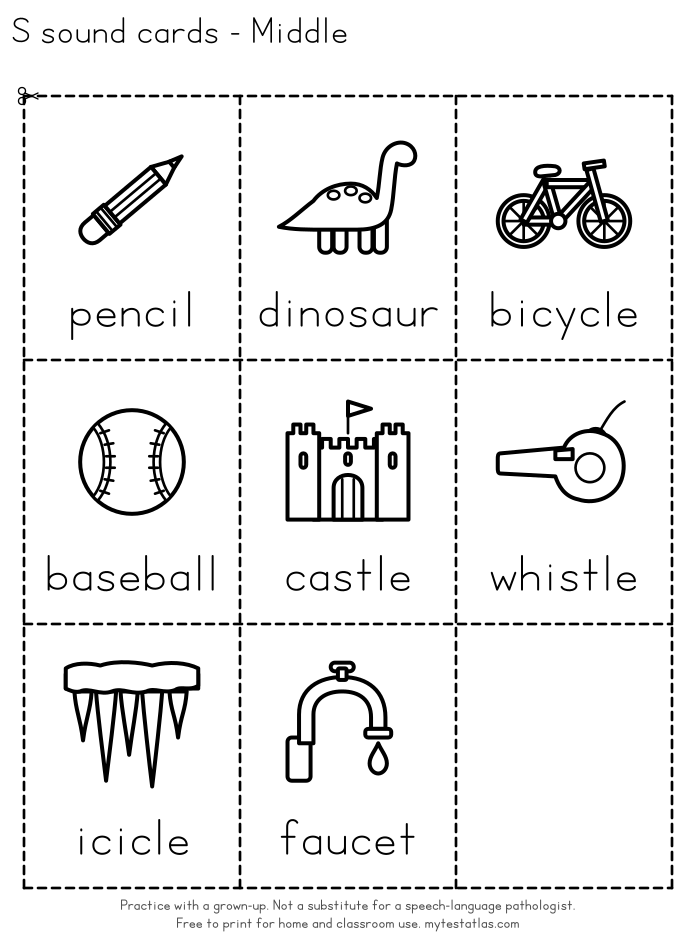
Middle
- pencil
- dinosaur
- bicycle
- baseball
- castle
- whistle
- icicle
- faucet
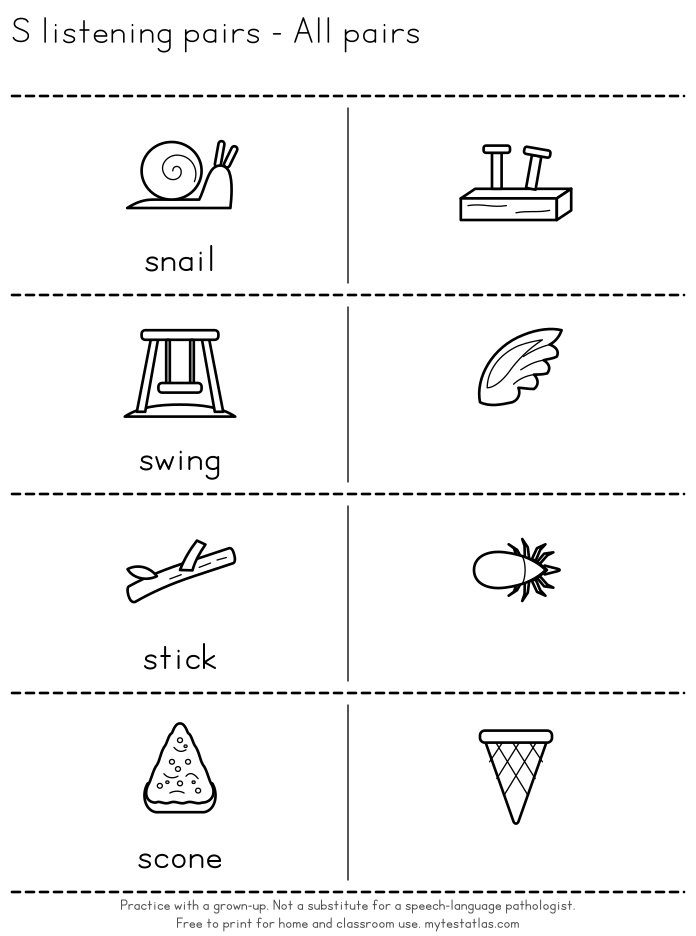
S minimal pairs
Pairs of pictures whose names differ only in the S sound, for the listening game or for printing.

 snail / nail
 swing / wing
 stick / tick
 scone / cone
S or TH

 moss / moth
Practising at home

- Short and often. Five to fifteen minutes, most days of the week, works better than one long session. Stop while it is still fun.
- Many tries, not many minutes. Speech practice builds with repetition. A round here is 10 tries; SLPs often aim for 50 to 100 tries in a session.
- Say it, then let your child say it. Model the word clearly. Do not ask for the same word more than 3 times, one after another.
- Start with words. Practising a sound on its own, like a long ‘sss’, is for children who can already say it sometimes. If your child cannot say it yet, play the listening game instead.
- Praise the effort. ‘Good trying!’ is better than ‘Wrong’. Never copy or tease the mistake.
- Model and recast in everyday talk. If your child says ‘Look, the thun’, answer ‘Yes, the sun! A big sun.’ No need to correct.
- Use a real mirror if it helps your child see their mouth. This page does not use the camera.
- Move up a step (sound, word, phrase, sentence) when most tries sound right. Move back any time.
- You are the listener. Tap Sounded right or Try again after each try. The page counts tries only; it does not keep your answers.
Listening first
Some children cannot yet hear the difference between their sound and the target, such as ‘moth’ and ‘moss’. Listening games are a safe, gentle supplement: they help a child notice the difference. On their own they are not a treatment, and they work best alongside practice or therapy.
About the S sound
- A lisp with the tongue between the teeth (‘thun’ for sun) is called a frontal lisp. It is common until about 4½.
- A slushy S, with air escaping at the sides of the mouth, is called a lateral lisp. It is not part of typical development at any age: ask for an evaluation.
- S sounds are quiet and high-pitched. Play the listening game in a quiet room, or with headphones.
- The S listening game uses S blends such as snail and nail. Pairs like mouse and mouth are left out because we only draw objects, never people or body parts.
Why there is no tongue gym here, and who the game is not for
- You will not find blowing, whistling, tongue push-ups or ‘tongue gym’ here. Research reviews found no good evidence that these exercises improve speech (ASHA evidence review, McCauley et al. 2009; Cochrane review, Lee & Gibbon 2015). Speech improves by practising speech.
- If your child is deaf or hard of hearing, the listening game will not suit them. Say it together and the printed cards still work, and your child’s audiologist or SLP can advise.
Other languages and dialects
- An accent or a dialect is not a speech problem. For example, ‘d’ or ‘f’ for ‘th’ is a regular feature of African American English and several other varieties of English.
- A child learning two languages may use sounds from both, such as a tapped or rolled R from Spanish. That is typical. An SLP can tell a language difference from a speech difficulty.
What this page remembers
What this page remembers. To let your child carry on, this page keeps, in this browser only, the step your child is on, how many tries they have made, the days practised this week and the stickers earned. It never keeps whether a try sounded right, and never records anything your child says. Nothing is sent to us. You can see or clear it any time under “Settings and progress”. Privacy policy, section 12
Questions
Is this speech therapy?
No. It is practice at home with a grown-up. A speech-language pathologist (SLP) can tell you whether your child needs therapy, and can plan it.
Does the page listen to my child?
No. It never uses the microphone and your browser is told not to allow it. You are the listener: you tap a button to count each try.
My child is 4 and says “thun” for sun. Should I worry?
A lisp with the tongue between the teeth is common until about 4½. A slushy S, with air escaping at the sides, is worth an evaluation at any age. The chart above shows typical ages, and the list above it says when to ask for an evaluation.
Is it free?
Yes. Every game and card is free, with no account and no advertising.
Can I print on A4?
Yes. The cards fit US Letter and A4 with the usual margins, in portrait.
Sources
- Crowe, K., & McLeod, S. (2020). Children’s English consonant acquisition in the United States: A review. American Journal of Speech-Language Pathology.
- American Speech-Language-Hearing Association (ASHA). Practice Portal: Speech Sound Disorders: Articulation and Phonology.
- Hustad, K. C., et al. (2021). Speech development between 30 and 119 months in typical children: intelligibility growth curves. Journal of Speech, Language, and Hearing Research.
- McCauley, R. J., Strand, E., Lof, G. L., Schooling, T., & Frymark, T. (2009). Evidence-based systematic review: effects of nonspeech oral motor exercises on speech. American Journal of Speech-Language Pathology.
- Lee, A. S.-Y., & Gibbon, F. E. (2015). Non-speech oral motor treatment for children with developmental speech sound disorders. Cochrane Database of Systematic Reviews.
- Sugden, E., Baker, E., Munro, N., Williams, A. L., & Trivette, C. M. (2018). Service delivery and intervention intensity for phonology-based speech sound disorders. International Journal of Language & Communication Disorders.