 For parents and teachers · ages 3 to 7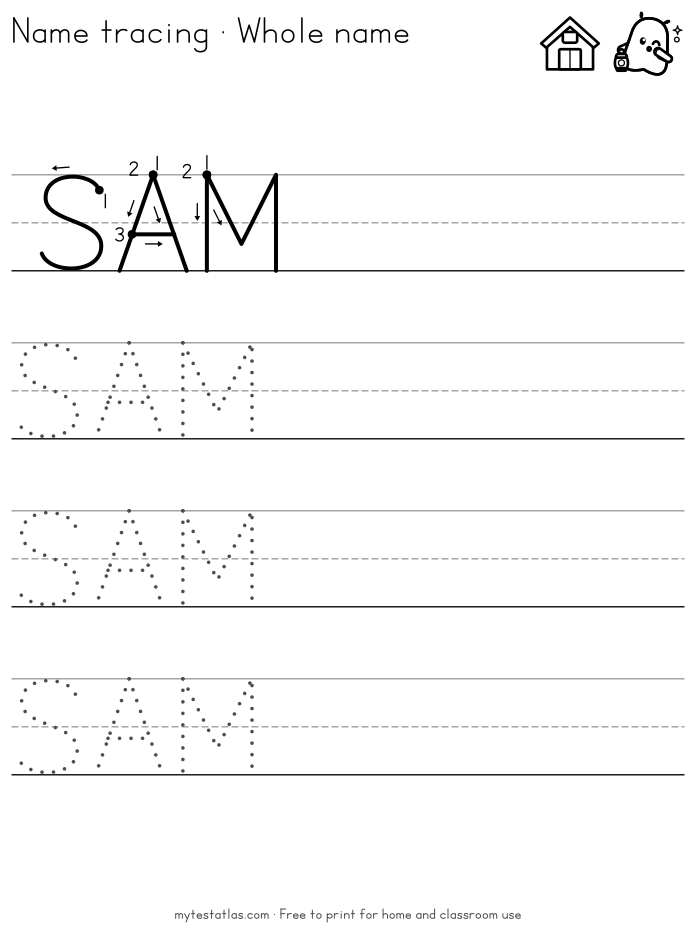
What is on a name tracing sheet
Type your child’s name and the page draws a sheet for that name. The first row shows the name as a model: each letter has a numbered start dot for every stroke and small arrows that show which way the stroke goes. Under it come dotted copies to trace, on three-line handwriting paper with a top line, a dashed midline and a baseline. The letters are drawn as lines, not set in a font, so they print crisp in black ink and use the same stroke order that the on-screen tracing checks. A small picture sits in the corner, and the footer says the sheet is free to print for home and classroom use.
Five stages, from first marks to writing it alone
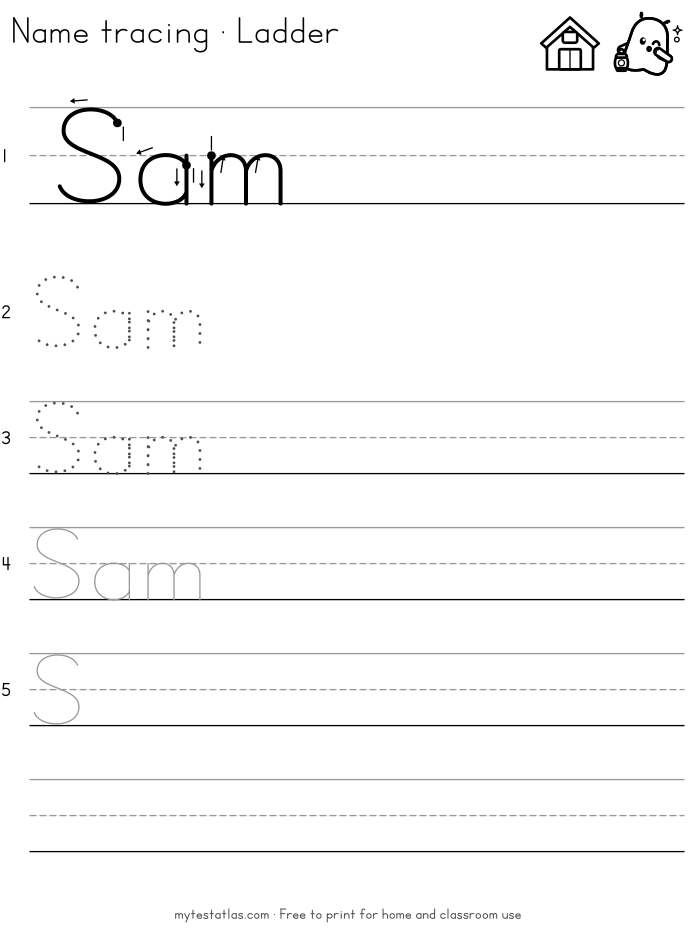
The sheets and the on-screen practice follow the same five stages, so a child can climb one step at a time.
- Warm-up (about 3): the lines, circles and curves that make up the letters of the name, as wide dotted tracks.
- Big letters (3 to 4): one letter of the name at a time, large, with the stroke order shown.
- Whole name (4 to 5): the whole name, traced from a model onto dotted rows.
- Dotted (5 and up): the name dotted on handwriting lines, then faint, then a blank row to try alone.
- On my own (5 to 7): paper only. The first letter as a hint, then blank lines, or the name from memory.
The ladder sheet puts all five stages on one page, which is a quick way to see where a child is.
Teaching a child to write their name, by age
Age 3. Most three-year-olds are still learning to hold a crayon and make lines on purpose. Warm-up tracks and big single letters are enough. Say the letter names as they trace, and stop while it is still fun.
Age 4. Many four-year-olds can trace the letters of their own name and start to copy a few. Capital letters are easier: they are made of straight lines and simple curves. Trace the whole name together and point to each letter as you say it.
Age 5. In kindergarten a child usually learns to write their name with a capital first letter and small letters after it. The dotted stage on handwriting lines matches what most classrooms use.
Age 6. Six-year-olds can often write their name alone. The On my own sheets, with only a first-letter hint or nothing at all, give them a reason to practice neat, even letters on the line.
Short and often beats long and rare: five minutes a day does more than one long session a week.
Capital letters or lowercase?
For children aged 3 and 4 the page uses all capitals by default, because capitals are made of the simplest strokes and are the letters young children recognize first. From the dotted stage on, and for ages 5 to 7, it writes the name with a capital first letter and small letters after it, which is what kindergarten teachers ask for. You can choose all capitals, first capital or all small letters under More options.
Left-handed children
Turn on the left-handed layout under More options. Each dotted row then repeats the model at its right end, so a left hand moving across the page does not cover the only example. On screen, left-hand mode moves the buttons to the other side, and a crossbar may be drawn from right to left.
Name tracing sheets for a whole class
Teachers can make a set of sheets for a whole class at once. Open “Make sheets for a class”, type one name per line, up to 40, and print: each child gets their own page with the same options. The names are used only to draw the sheets while the print preview is open. They are never remembered or sent.
Color my name
The Color my name sheet draws the name in big bubble letters to color in, with a picture from the farm, the sea or space, and one line to write the name. It is a gentle first sheet for a child who is not ready to trace yet.
How the on-screen tracing works
Press “Play on this device” and hand over the phone or tablet. A little lantern friend, a friendly night-light character with a moon lantern, shows each stroke with a yellow star, and a quiet, calm voice says what to do, so a child who cannot read yet can follow along. Now and then the lantern friend whispers a short “psst” before a new letter; every instruction and letter name is then said clearly, on its own. The child traces with a finger. A stroke that follows the letter turns solid; a stroke that wanders is shown again, gently, with no red marks and no scores. Every round ends with a sticker. To leave, a grown-up holds the lock at the top for two seconds and answers a short question.
The letters we use
The letters on these sheets are our own simple school print, sometimes called ball and stick: straight lines, circles and parts of circles, upright, with tall lines drawn from the top down and round letters drawn counter-clockwise. The numbers on each letter show the order of the strokes and the arrows show which way to go. Schools teach a few letters in slightly different ways. If your child’s school writes a letter differently, follow the school; the on-screen tracing accepts the common variations.
What this page remembers
What this page remembers. To let your child carry on where they stopped, this page keeps their progress (which stages are done, and the stickers earned) in this browser only. No name is kept unless you choose to, and nothing is sent to us. You can see or clear it any time under “Settings and progress”. Privacy policy, section 12
Questions
- Is it free?
- Yes. Every sheet and the on-screen tracing are free, with no account and no advertising. All current activities are free.
- Does it work on a phone?
- Yes. The sheets print from a phone, and the on-screen tracing works on a phone or a tablet. On a small phone a long name is drawn smaller, so a tablet gives bigger letters.
- Can I print on A4?
- Yes. Every sheet fits inside a box that prints on US Letter and A4 paper with the usual margins, in portrait.
- Why does my child’s school write a letter differently?
- Schools teach a few letters in slightly different ways. Follow the school; the on-screen tracing accepts the common variations.
- Is my child’s name sent anywhere?
- No. The name is used only to draw the sheet in your browser and is never sent to us.