The engine, shown
Examples of what the engine makes
Real items from the generators behind the tests and the API: figure matrices, series and logic puzzles, each with its answer, plus screens from the tests themselves.
Each example below is drawn from its seed by the same generator the API serves: ask the API for one item of that kind with the same seed and you get the same item.
Figure matrices
3 × 3 grids of drawn figures with one cell missing; exactly one option is proved to fit every rule. API reference
 A
A B
B C
C D
DAnswer
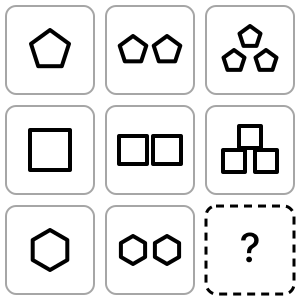
B Each row keeps one shape while the number of shapes grows one, two, three across the columns. The missing figure is 3 outlined hexagons; it is the only one of 675 candidate figures that satisfies every rule the stem shows.
 A
A B
B C
C D
D E
EAnswer
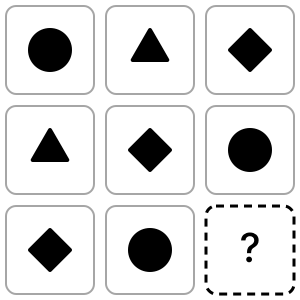
C Every row and every column holds each of the three shapes exactly once. The missing figure is 1 filled triangle; it is the only one of 675 candidate figures that satisfies every rule the stem shows.
 A
A B
B C
C D
D E
E F
FAnswer
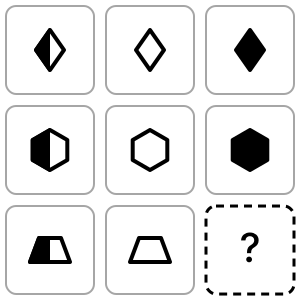
C The row fixes the shape and the column fixes the fill. The missing figure is 1 filled trapezoid; it is the only one of 1539 candidate figures that satisfies every rule the stem shows.
Figure series
Four drawn figures in a row; exactly one option continues the rule. API reference

 A
A B
B C
C D
DAnswer
D The fill cycles outline, half, solid while the shape and the number of shapes stay the same. The missing figure is 1 filled diamond; it is the only one of 675 candidate figures that satisfies every rule the stem shows.

 A
A B
B C
C D
D E
EAnswer
E Three shapes take turns in a fixed order while the fill stays the same. The missing figure is 1 filled diamond; it is the only one of 675 candidate figures that satisfies every rule the stem shows.

 A
A B
B C
C D
D E
E F
FAnswer
F The shape turns a further 45 degrees at every step, always the same way. The missing figure is 1 half-filled triangle turned 75 degrees; it is the only one of 72 candidate figures that satisfies every rule the stem shows.
Mental rotation
Which option is the figure turned by the stated angle? API reference
Which option shows the figure rotated 45° clockwise?

 A
A B
B C
C D
DAnswer
B Option B is the starting figure turned 45° clockwise; every other option is turned by a different angle or is a mirror image.
Which option shows the figure rotated 90° clockwise?

 A
A B
B C
C D
DAnswer
A Option A is the starting figure turned 90° clockwise; every other option is turned by a different angle or is a mirror image.
Which option shows the figure rotated 135° clockwise?

 A
A B
B C
C D
DAnswer
C Option C is the starting figure turned 135° clockwise; every other option is turned by a different angle or is a mirror image.
Mirror images
Which option is the figure mirrored left to right? API reference
Which option shows the figure mirrored left to right?

 A
A B
B C
C D
DAnswer
B Option B is the starting figure reflected left to right; every other option is the figure turned without reflection, or reflected and turned.
Which option shows the figure mirrored left to right?

 A
A B
B C
C D
DAnswer
A Option A is the starting figure reflected left to right; every other option is the figure turned without reflection, or reflected and turned.
Which option shows the figure mirrored left to right?

 A
A B
B C
C D
DAnswer
C Option C is the starting figure reflected left to right; every other option is the figure turned without reflection, or reflected and turned.
Syllogisms
Two premises over invented categories; which conclusion follows? Checked against all 256 ways three sets can overlap. API reference
All Zhodon are Zhisir. All Trethir are Zhodon. Which of these follows?
Answer
A Checked against all 256 ways three categories can overlap: 16 of them fit both statements, and “All Trethir are Zhisir” is true in every one. Nothing here says any Trethir exists, so “all” never implies “some”.
All Vrelel are Tridir. No Kruthep are Tridir. Which of these follows?
Answer
B Checked against all 256 ways three categories can overlap: 16 of them fit both statements, and “No Kruthep are Vrelel” is true in every one. Nothing here says any Kruthep exists, so “all” never implies “some”.
All Zanol are Skorir. All Glethon are Zanol. Which of these follows?
Answer
D Checked against all 256 ways three categories can overlap: 16 of them fit both statements, and “All Glethon are Skorir” is true in every one. Nothing here says any Glethon exists, so “all” never implies “some”.
Propositional logic
Statements about P, Q and R; which must be true? Checked against all 8 rows of the truth table. API reference
At least one of these is true: Q does not hold; P does not hold. If P does not hold, then Q holds. At least one of these is true: R does not hold; Q holds. Which of these must be true?
Answer
D Of the 8 combinations of P, Q and R, 3 fit every statement above. Each of the other three answers is false in at least one of those 3, so none of them has to be true.
At least one of these is true: R does not hold; Q does not hold. At least one of these is true: P holds; R does not hold. If P does not hold, then R holds. Which of these must be true?
Answer
D Of the 8 combinations of P, Q and R, 3 fit every statement above, and “P is true” holds in all 3. Each other answer fails in at least one of them.
If R does not hold, then P holds. At least one of these is true: Q does not hold; R holds. If Q does not hold, then P does not hold. Which of these must be true?
Answer
B Of the 8 combinations of P, Q and R, 3 fit every statement above, and “R is true” holds in all 3. Each other answer fails in at least one of them.
Ordering puzzles
Five invented names in a row and a few clues; which place does one of them take? Checked against all 120 arrangements. API reference
Brothel, Vanuk, Trethir, Zhodon, Zhisir stand in a row, first to fifth. Zhodon is immediately before Zhisir. Brothel is not second. Zhodon is third. Vanuk is first. Which place is Brothel in?
Answer
E Of the 120 ways five names can stand in a row, exactly one fits all 4 clues: Vanuk, Trethir, Zhodon, Zhisir, Brothel. Every clue is needed — drop any one and a second arrangement fits.
Skerel, Plidol, Kruthep, Tridir, Vrelel stand in a row, first to fifth. Vrelel is immediately before Plidol. Kruthep and Tridir are not next to each other. Kruthep is immediately before Vrelel. Tridir is somewhere before Plidol. Which place is Plidol in?
Answer
E Of the 120 ways five names can stand in a row, exactly one fits all 4 clues: Tridir, Skerel, Kruthep, Vrelel, Plidol. Every clue is needed — drop any one and a second arrangement fits.
Skarir, Vidath, Glethon, Zanol, Skorir stand in a row, first to fifth. Vidath is immediately before Zanol. Glethon is somewhere before Vidath. Skorir is fourth. Which place is Vidath in?
Answer
B Of the 120 ways five names can stand in a row, exactly one fits all 3 clues: Glethon, Vidath, Zanol, Skorir, Skarir. Every clue is needed — drop any one and a second arrangement fits.
Verbal reasoning
A passage about invented organisations and a statement: true, false or cannot say, keyed over every situation the passage leaves open. API reference
Four design studios — Vanuk, Trethir, Zhodon and Zhisir — work across the festivals of Krudon, Brithel, Skaruk and Druson. Trethir exhibited at Krudon, Brithel and Skaruk and at no other festival. If Vanuk exhibited at Skaruk, it also exhibited at Krudon. Vanuk exhibited at Brithel. Zhisir is the oldest of the four. Zhodon was set up before Trethir. Vanuk exhibited at Druson. Vanuk exhibited at Krudon. Statement: Zhisir was set up before Vanuk. Based only on the passage, is the statement true, false, or can you not say?
Answer
A The passage leaves 6 of 6144 possible situations open (orders in which the four began × the festivals Vanuk and Trethir could be linked to). The statement is "True" because it holds in all 6. Only what the passage says counts — not what would be likely.
Four design studios — Plidol, Kruthep, Tridir and Vrelel — work across the festivals of Brunir, Gluthuk, Draman and Skudath. If Plidol exhibited at Draman, it also exhibited at Brunir. Plidol did not exhibit at Draman. Plidol is the youngest of the four. Plidol exhibited at Brunir. Plidol did not exhibit at Skudath. Kruthep exhibited at Skudath. Kruthep did not exhibit at Gluthuk. Statement: Both Plidol and Kruthep exhibited at Gluthuk. Based only on the passage, is the statement true, false, or can you not say?
Answer
B The passage leaves 48 of 6144 possible situations open (orders in which the four began × the festivals Plidol and Kruthep could be linked to). The statement is "False" because it holds in none of the 48. Only what the passage says counts — not what would be likely.
Four design studios — Vidath, Glethon, Zanol and Skorir — work across the festivals of Glodon, Glumuk, Theluk and Kroron. Vidath exhibited at Kroron and at no other festival. Glethon was set up before Skorir. Glethon exhibited at Glodon. Zanol was set up before Vidath. Glethon is the oldest of the four. Statement: Zanol was set up before Skorir. Based only on the passage, is the statement true, false, or can you not say?
Answer
C The passage leaves 24 of 6144 possible situations open (orders in which the four began × the festivals Vidath and Glethon could be linked to). The statement is "Cannot say" because it holds in 16 of the 24 and fails in the other 8. Only what the passage says counts — not what would be likely.
Numerical reasoning
Read a table and compute one figure; the wrong options are what the usual mistakes produce. API reference
Orders shipped by warehouse (thousands) | Warehouse | 2022 | 2023 | 2024 | | --------- | ---- | ---- | ---- | | Vanuk | 95 | 110 | 136 | | Trethir | 129 | 187 | 195 | | Zhodon | 144 | 116 | 116 | | Zhisir | 87 | 71 | 76 | By what percentage did Trethir's figure change from 2023 to 2024? Give the answer to one decimal place (a fall is negative).
Answer
D (195 − 187) ÷ 187 × 100 = 4.3%. The base of a percentage change is the earlier year.
Orders shipped by warehouse (thousands) | Warehouse | 2022 | 2023 | 2024 | | --------- | ---- | ---- | ---- | | Plidol | 177 | 190 | 184 | | Kruthep | 212 | 167 | 215 | | Tridir | 77 | 78 | 103 | | Vrelel | 166 | 134 | 161 | What share of the 2022 total came from Vrelel? Give the answer to one decimal place.
Answer
D 166 ÷ 632 (the 2022 column total) × 100 = 26.3%.
Orders shipped by warehouse (thousands) | Warehouse | 2022 | 2023 | 2024 | | --------- | ---- | ---- | ---- | | Vidath | 142 | 151 | 124 | | Glethon | 91 | 101 | 85 | | Zanol | 49 | 61 | 65 | | Skorir | 215 | 292 | 275 | Taking Vidath and Skorir together, by how many percentage points did Vidath's share of their combined figure change from 2022 to 2024? One decimal place (a fall is negative).
Answer
C 2022: 142 ÷ 357 = 39.8%. 2024: 124 ÷ 399 = 31.1%. 31.1 − 39.8 = -8.7 points. A change in points is a subtraction of shares, not a percentage of one.
Sudoku
4 × 4, 6 × 6 and 9 × 9 grids with exactly one solution, graded by the techniques a logical solver needed. API reference
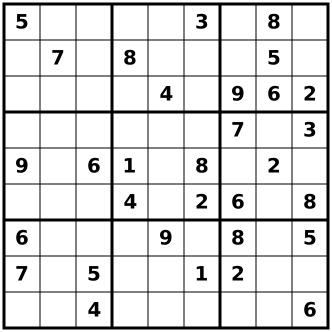
Fill the 9 × 9 grid so that every row, every column and every 3 × 3 box contains each digit from 1 to 9 exactly once. 31 digits are given.
Answer
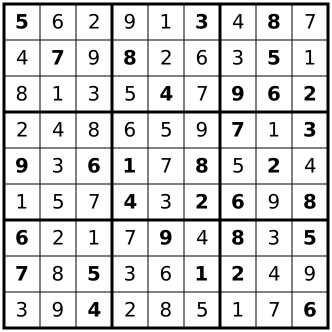 Unique: a backtracking solver found exactly one solution. Solvable without guessing by naked singles ×50 (hardest technique: tier 1 of 4).
Fill the 9 × 9 grid so that every row, every column and every 3 × 3 box contains each digit from 1 to 9 exactly once. 24 digits are given.
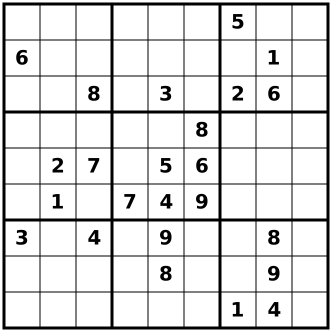
Answer
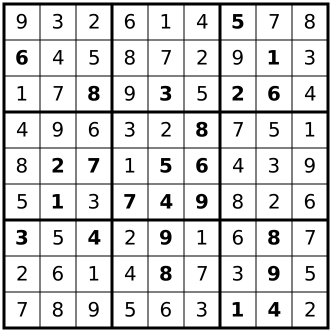 Unique: a backtracking solver found exactly one solution. Solvable without guessing by naked singles ×43, hidden singles ×14 (hardest technique: tier 1 of 4).
Fill the 9 × 9 grid so that every row, every column and every 3 × 3 box contains each digit from 1 to 9 exactly once. 25 digits are given.
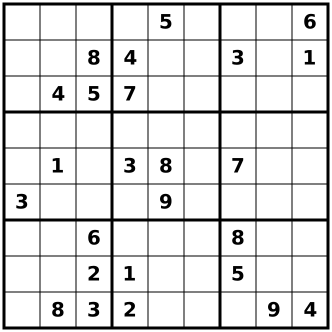
Answer
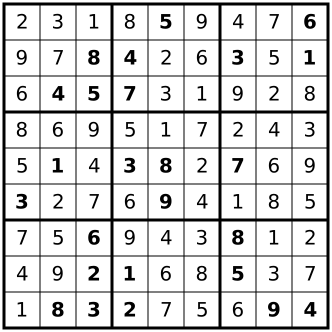 Unique: a backtracking solver found exactly one solution. Solvable without guessing by naked singles ×41, hidden singles ×15, locked candidates ×7 (hardest technique: tier 2 of 4).
Nonograms
Picture grids from row and column run lengths, 5 × 5 to 15 × 15, each proved solvable by line logic alone — so unique and guess-free. API reference
Fill cells in this 8 × 8 grid so that each row and each column shows runs of filled cells of the given lengths, in order, with at least one empty cell between runs.
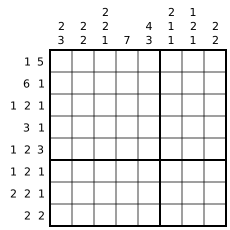
Answer
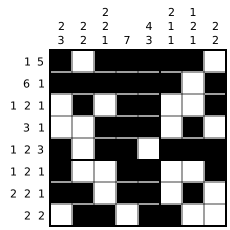 Line-solvable in 4 passes: 22 line deductions, each forced by every placement of that line's runs, fill all 64 cells (40 filled). A grid that line logic fixes completely has exactly one solution.
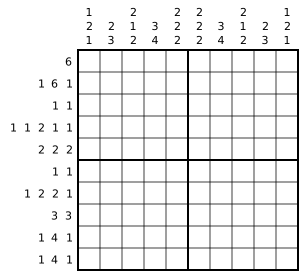
Fill cells in this 10 × 10 grid so that each row and each column shows runs of filled cells of the given lengths, in order, with at least one empty cell between runs.
Answer
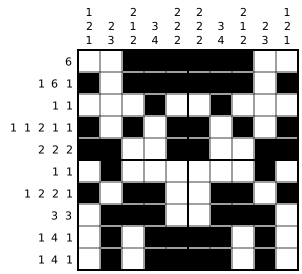 Line-solvable in 2 passes: 22 line deductions, each forced by every placement of that line's runs, fill all 100 cells (54 filled). A grid that line logic fixes completely has exactly one solution.
Fill cells in this 12 × 12 grid so that each row and each column shows runs of filled cells of the given lengths, in order, with at least one empty cell between runs.
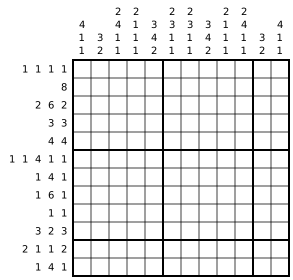
Answer
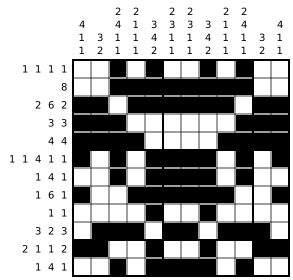 Line-solvable in 4 passes: 40 line deductions, each forced by every placement of that line's runs, fill all 144 cells (80 filled). A grid that line logic fixes completely has exactly one solution.
Calcudoku
Latin squares behind arithmetic cages (+ − × ÷), 4 × 4 to 6 × 6, each with exactly one solution proved by a solver. API reference
Fill the 5 × 5 grid with the digits 1 to 5 so that each digit appears once in every row and every column. Each outlined cage shows a target and an operation: its digits must add, multiply, subtract (larger minus smaller) or divide (larger by smaller) to the target.
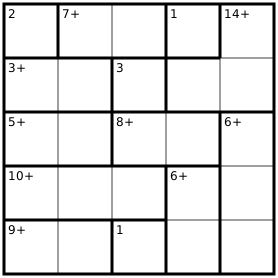
Answer
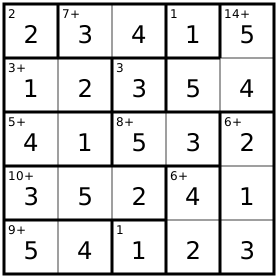 Unique: a constraint solver that enumerates each cage's possible digits and branches on the tightest cell found exactly one solution (123 cage tuples tested, 0 trials). 13 cages using add; 4 one-cell cages give its digit.
Fill the 5 × 5 grid with the digits 1 to 5 so that each digit appears once in every row and every column. Each outlined cage shows a target and an operation: its digits must add, multiply, subtract (larger minus smaller) or divide (larger by smaller) to the target.
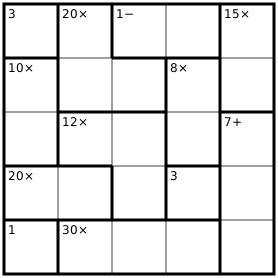
Answer
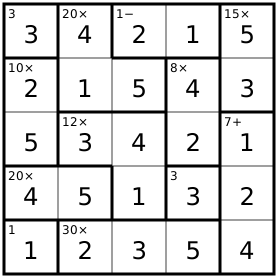 Unique: a constraint solver that enumerates each cage's possible digits and branches on the tightest cell found exactly one solution (180 cage tuples tested, 0 trials). 12 cages using multiply, subtract, add; 3 one-cell cages give its digit.
Fill the 5 × 5 grid with the digits 1 to 5 so that each digit appears once in every row and every column. Each outlined cage shows a target and an operation: its digits must add, multiply, subtract (larger minus smaller) or divide (larger by smaller) to the target.
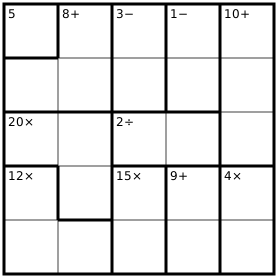
Answer
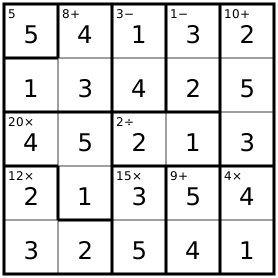 Unique: a constraint solver that enumerates each cage's possible digits and branches on the tightest cell found exactly one solution (315 cage tuples tested, 0 trials). 11 cages using add, multiply, subtract, divide; 1 one-cell cage gives its digit.
Logic grid puzzles
Zebra-style puzzles in plain English, 3 × 3 to 5 × 5, each proved to have one solution by a solver that never guesses, with its deduction chain. API reference
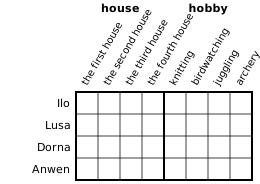
4 people each have exactly one of every item below, and no two share one. The houses stand in a row, numbered first to fourth from left to right. Categories (names: Ilo, Lusa, Dorna, Anwen; house: the first house, the second house, the third house, the fourth house; hobby: knitting, birdwatching, juggling, archery). Clues: 1. The person who enjoys birdwatching lives in the third house. 2. Lusa enjoys juggling. 3. Dorna does not enjoy knitting. 4. The person who enjoys knitting lives in the second house. 5. Anwen lives in the third house. 6. Dorna lives in either the second or the first house. Which hobby does Anwen enjoy?
Answer
B The clues allow exactly one arrangement, found in 21 deductions without guessing. The decisive one: Anwen does not enjoy archery (Dorna enjoys archery), so Anwen enjoys birdwatching. So the answer is birdwatching.
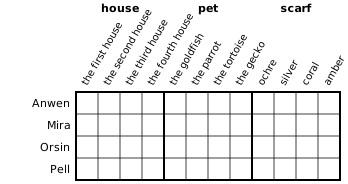
4 people each have exactly one of every item below, and no two share one. The houses stand in a row, numbered first to fourth from left to right. Categories (names: Anwen, Mira, Orsin, Pell; house: the first house, the second house, the third house, the fourth house; pet: the goldfish, the parrot, the tortoise, the gecko; scarf: ochre, silver, coral, amber). Clues: 1. Mira does not keep the goldfish. 2. The person in the ochre scarf keeps the tortoise. 3. Pell lives in the third house. 4. Pell does not wear the amber scarf. 5. Pell keeps the parrot. 6. Anwen keeps either the tortoise or the parrot. 7. The gecko's owner does not wear the silver scarf. 8. The person in the silver scarf lives in the fourth house. 9. Anwen lives immediately left of the person in the coral scarf. Who lives in the first house?
Answer
B The clues allow exactly one arrangement, found in 32 deductions without guessing. The decisive one: Mira does not live in the second house (Anwen lives in the second house), so Mira lives in the first house. So the answer is Mira.
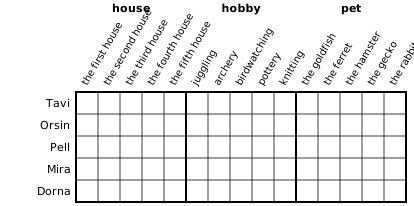
5 people each have exactly one of every item below, and no two share one. The houses stand in a row, numbered first to fifth from left to right. Categories (names: Tavi, Orsin, Pell, Mira, Dorna; house: the first house, the second house, the third house, the fourth house, the fifth house; hobby: juggling, archery, birdwatching, pottery, knitting; pet: the goldfish, the ferret, the hamster, the gecko, the rabbit). Clues: 1. The hamster's owner lives next to the ferret's owner. 2. The person who enjoys pottery lives somewhere left of Pell. 3. Pell does not live in the third house. 4. The gecko's owner lives in the second house. 5. Orsin lives in either the third or the second house. 6. Mira does not live in the fourth house. 7. The gecko's owner does not enjoy pottery. 8. Orsin does not enjoy knitting. 9. Tavi enjoys archery. 10. The goldfish's owner does not enjoy pottery. 11. Dorna li…
Answer
A The clues allow exactly one arrangement, found in 48 deductions without guessing. The decisive one: Pell does not keep the ferret (Mira keeps the ferret), so Pell keeps the goldfish. So the answer is the goldfish.
Number series
What number comes next: arithmetic to interleaved and recursive rules, unique under a stated rule grammar, with near-rule distractors. API reference
What number comes next? 320, 160, 80, 40, 20, 10, …
Answer
B The rule: divide by 2 each time. So the next term is 5. Checked against 8 rule types (arithmetic, geometric, quadratic, Fibonacci-like, linear recurrence, growing differences, alternating operations, interleaved series): every one that fits all 6 terms gives 5.
What number comes next? 11, 35, 16, 38, 21, 41, 26, …
Answer
C The rule: two series take turns: 11, 16, … adds 5; 35, 38, … adds 3. So the next term is 44. Checked against 8 rule types (arithmetic, geometric, quadratic, Fibonacci-like, linear recurrence, growing differences, alternating operations, interleaved series): every one that fits all 7 terms gives 44.
What number comes next? 9, 1, 10, 11, 21, 32, …
Answer
D The rule: each term is the sum of the two before it. So the next term is 53. Checked against 8 rule types (arithmetic, geometric, quadratic, Fibonacci-like, linear recurrence, growing differences, alternating operations, interleaved series): every one that fits all 6 terms gives 53.
Letter series
What comes next in a series of letters or letter groups, with wrap-around counting; unique under a stated rule grammar. API reference
What comes next? Counting wraps around: after Z comes A. C, I, O, U, A, G, …
Answer
B The rule: move forward 6 letters each time. So the next letter is M. Each position was checked against 4 rule types (constant step, changing step, interleaved series, alternating steps), and every fitting rule gives M.
What comes next? Counting wraps around: after Z comes A. L, O, S, X, D, K, S, …
Answer
B The rule: the step grows by 1 each time (3, 4, 5, …). So the next letter is B. Each position was checked against 4 rule types (constant step, changing step, interleaved series, alternating steps), and every fitting rule gives B.
What comes next? Counting wraps around: after Z comes A. VE, WH, XK, YN, ZQ, …
Answer
C The rule: in each pair the first letter moves forward 1 and the second forward 3. So the next group is AT. Each position was checked against 4 rule types (constant step, changing step, interleaved series, alternating steps), and every fitting rule gives AT.
Belief-bias syllogisms
Syllogisms about real categories whose validity and believability disagree; validity proved over all 256 models. API reference
Assume both statements are true, even if they are not true in the real world, and read “all” without assuming that anything of that kind exists. 1. All saws are carrots. 2. All bats are saws. Conclusion: All bats are carrots. Is the argument valid?
Answer
A Valid. Of the 256 ways three categories can overlap, 16 make both premises true, and “All bats are carrots” is true in every one of them. In the real world the conclusion is false, which has no bearing on whether it follows.
Assume both statements are true, even if they are not true in the real world, and read “all” without assuming that anything of that kind exists. 1. All daisies are sharks. 2. Some horses are not sharks. Conclusion: No horses are daisies. Is the argument valid?
Answer
B Invalid. The premises can both be true while the conclusion is false: suppose the only things are things that are horses but not sharks or daisies; things that are horses and sharks and daisies. In the real world the conclusion is true, which has no bearing on whether it follows.
Assume both statements are true, even if they are not true in the real world, and read “all” without assuming that anything of that kind exists. 1. No mammals are ants. 2. Some ants are bats. Conclusion: Some bats are not mammals. Is the argument valid?
Answer
A Valid. Of the 256 ways three categories can overlap, 32 make both premises true, and “Some bats are not mammals” is true in every one of them. In the real world the conclusion is false, which has no bearing on whether it follows.
Base-rate problems
Screening, witness, spam and inspection problems with an exact Bayesian answer and computed base-rate-neglect lures. API reference
A mail server runs a filter that flags suspicious messages. Out of 10,000 emails, 500 are spam. Of the emails that are spam, 80% get flagged by the filter. Of the emails that are legitimate, 15% also get flagged by the filter. Of the emails that get flagged by the filter, what share are spam?
Answer
D In natural frequencies: 80% of 500 = 400 are spam and get flagged by the filter. 15% of 9,500 = 1,425 are legitimate but get flagged by the filter anyway. 400 + 1,425 = 1,825 emails get flagged by the filter. Of those, 400 are spam: 400/1,825 = 16/73 ≈ 21.9%. The answer is exactly 16 in 73. Answering 80% is base-rate neglect: that is how often emails that are spam get flagged by the filter, not how often emails that get flagged by the filter are spam.
A factory checks every part with an inspection camera. 10% of parts from the line are defective. Of the parts from the line that are defective, 95% get rejected by the inspection camera. Of the parts from the line that are sound, 6% also get rejected by the inspection camera. Of the parts from the line that get rejected by the inspection camera, what share are defective?
Answer
D In natural frequencies: Picture 1,000 parts from the line: 10% of them is 100 that are defective, and 900 that are sound. 95% of 100 = 95 are defective and get rejected by the inspection camera. 6% of 900 = 54 are sound but get rejected by the inspection camera anyway. 95 + 54 = 149 parts from the line get rejected by the inspection camera. Of those, 95 are defective: 95/149 = 95/149 ≈ 63.8%. The answer is exactly 95 in 149. Answering 95% is base-rate neglect: that is how often parts from the line that are defective get rejected by the inspection camera, not how often parts from the line that get rejected by the inspection camera are defective.
A mail server runs a filter that flags suspicious messages. 2.5% of emails are spam. Of the emails that are spam, 90% get flagged by the filter. Of the emails that are legitimate, 95% correctly pass the filter. Of the emails that get flagged by the filter, what share are spam?
Answer
D In natural frequencies: Picture 100,000 emails: 2.5% of them is 2,500 that are spam, and 97,500 that are legitimate. 95% pass the filter correctly, so 5% of those that are legitimate get flagged by the filter anyway. 90% of 2,500 = 2,250 are spam and get flagged by the filter. 5% of 97,500 = 4,875 are legitimate but get flagged by the filter anyway. 2,250 + 4,875 = 7,125 emails get flagged by the filter. Of those, 2,250 are spam: 2,250/7,125 = 6/19 ≈ 31.6%. The answer is exactly 6 in 19. Answering 90% is base-rate neglect: that is how often emails that are spam get flagged by the filter, not how often emails that get flagged by the filter are spam.
Reflection puzzles
Short everyday number problems with a tempting first answer; the lure is computed from the same numbers as the key. API reference
It takes 6 minutes to saw a plank into 4 pieces. Working at the same pace, how many minutes does it take to saw an identical plank into 8 pieces?
Answer
A The quick answer is 12 minutes: Scaling by pieces (6 × 8 ÷ 4 = 12) forgets that 4 pieces take only 3 cuts. 4 pieces need 3 cuts, so each cut takes 6 ÷ 3 = 2 minutes; 8 pieces need 7 cuts: 7 × 2 = 14.
A store marks a tent down by 20%, then takes another 20% off the reduced price at checkout. What is the total discount on the original price, in percent?
Answer
C The quick answer is 40%: 20% + 20% = 40% takes the second discount from the original price, but it comes off the already reduced one. Start at 100: 20% off leaves 80; 20% off 80 leaves 64. The total discount is 36%.
A store marks a backpack down by 25%, then takes another 30% off the reduced price at checkout. What is the total discount on the original price, in percent?
Answer
C The quick answer is 55%: 25% + 30% = 55% takes the second discount from the original price, but it comes off the already reduced one. Start at 100: 25% off leaves 75; 30% off 75 leaves 52.5. The total discount is 47.5%.
Selection tasks
Four cards and a rule: which cards must be turned to test it? Everyday rules and abstract ones, with negations. API reference
A rule applies to students at a school library: "If a student borrows a reference book, it must not be returned the same day." Each card describes one loan: the kind of book on one side, and when it came back on the other. You can see one side of each card. Card 1: returned it a week later. Card 2: returned it the same day. Card 3: borrowed a reference book. Card 4: borrowed a novel. Which cards must you turn over to find out whether the rule has been broken? Answer with the card numbers.
Answer
2,3 Only a case where the condition holds and the requirement fails breaks the rule. So turn cards 2 and 3: card 2 (returned it the same day) fails the requirement, so if the other side meets the condition the rule is broken; card 3 (borrowed a reference book) meets the condition, so the other side could break the rule. The other two cannot show a violation.
Each card has a letter on one side and a shape on the other. Someone claims: "If a card has a vowel on one side, then it has a circle on the other side." You can see one side of each card. Card 1: U. Card 2: triangle. Card 3: circle. Card 4: T. Which cards must you turn over to find out whether the rule has been broken? Answer with the card numbers.
Answer
1,2 Only a case where the condition holds and the requirement fails breaks the rule. So turn cards 1 and 2: card 1 (U) meets the condition, so the other side could break the rule; card 2 (triangle) fails the requirement, so if the other side meets the condition the rule is broken. The other two cannot show a violation.
Each card has a number on one side and a color on the other. Someone claims: "If a card has an even number on one side, then it does not have the color red on the other side." You can see one side of each card. Card 1: 3. Card 2: red. Card 3: 4. Card 4: green. Which cards must you turn over to find out whether the rule has been broken? Answer with the card numbers.
Answer
2,3 Only a case where the condition holds and the requirement fails breaks the rule. So turn cards 2 and 3: card 2 (red) fails the requirement, so if the other side meets the condition the rule is broken; card 3 (4) meets the condition, so the other side could break the rule. The other two cannot show a violation.
Conjunction problems
A short description of an invented person, then: which statement is more probable? A single event always beats its conjunctions. API reference
Mateo is 43. Mateo keeps a journal of the birds they spot and spends most weekends on long hikes. Which is more probable?
Answer
B Every situation in which option A is true is also one in which Mateo is an insurance agent, so it cannot be more probable than B: for any events X and Y, P(X and Y) ≤ P(X). The description fits "belongs to a birdwatching club" much better than "is an insurance agent", which is what makes a conjunction feel likelier. It cannot be: adding a detail can only remove cases.
Felix is 46. Felix is the first to visit a sick friend, majored in social work and organizes the neighborhood potluck every year. Which is most probable?
Answer
A Every situation in which any of options B or C is true is also one in which Felix works as a bank teller, so none of them can be more probable than A: for any events X and Y, P(X and Y) ≤ P(X). The description fits "volunteers at a food bank" much better than "works as a bank teller", which is what makes a conjunction feel likelier. It cannot be: adding a detail can only remove cases.
Anton is 43. Anton is the first to visit a sick friend, remembers everyone's birthday and majored in social work. Which of these statements must be at least as probable as each of the others?
Answer
A Every situation in which any of options B or C is true is also one in which Anton works as a bank teller, so none of them can be more probable than A: for any events X and Y, P(X and Y) ≤ P(X). The description fits "volunteers at a food bank" much better than "works as a bank teller", which is what makes a conjunction feel likelier. It cannot be: adding a detail can only remove cases.
Covariation tables
2 × 2 contingency tables: does the treatment help? Keyed by the exact ΔP, with the big-cell lure computed. API reference
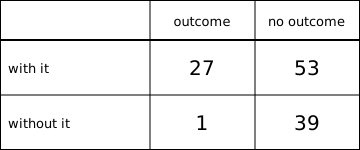
A trial followed 120 screens. 80 had the anti-glare coating and 40 did not. With the anti-glare coating, 27 were returned as faulty and 53 did not. Without it, 1 were returned as faulty and 39 did not. Judging only from these numbers, does the anti-glare coating help?
Answer
C With the anti-glare coating: 27 of 80 were returned as faulty (33.8%). Without it: 1 of 40 (2.5%). The difference ΔP = 33.8% − 2.5% = 5/16 (31.3%), so the outcome is more likely with it, which is worse.
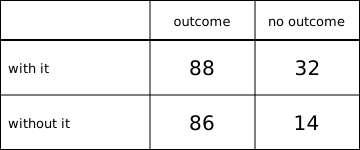
A trial followed 220 runners. 120 had the warm-up routine and 100 did not. With the warm-up routine, 88 picked up an injury during the season and 32 did not. Without it, 86 picked up an injury during the season and 14 did not. Judging only from these numbers, does the warm-up routine help?
Answer
A With the warm-up routine: 88 of 120 picked up an injury during the season (73.3%). Without it: 86 of 100 (86%). The difference ΔP = 73.3% − 86% = -19/150 (-12.7%), so the outcome is less likely with it, which is better. The biggest cell (88) is a lure: it only counts the successes with the warm-up routine, not the rate without it.
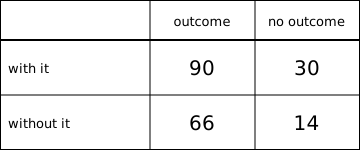
A trial followed 200 patients. 120 had the soothing cream and 80 did not. With the soothing cream, 90 still had the rash after ten days and 30 did not. Without it, 66 still had the rash after ten days and 14 did not. Judging only from these numbers, does the soothing cream help?
Answer
A With the soothing cream: 90 of 120 still had the rash after ten days (75%). Without it: 66 of 80 (82.5%). The difference ΔP = 75% − 82.5% = -3/40 (-7.5%), so the outcome is less likely with it, which is better. The biggest cell (90) is a lure: it only counts the successes with the soothing cream, not the rate without it.
Screens from the tests
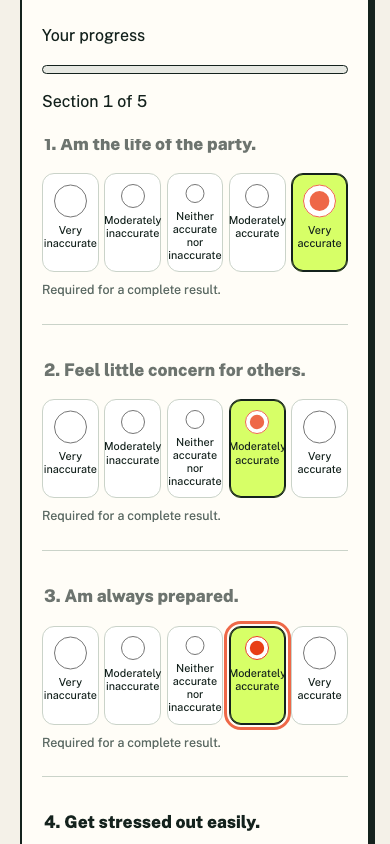
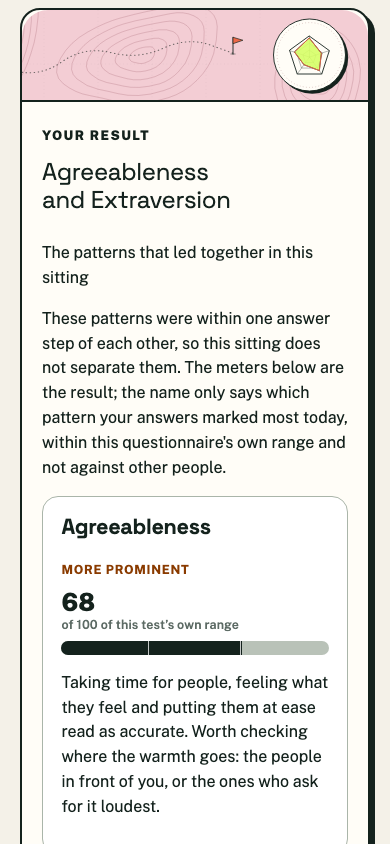
Printable worksheets
Pick a family, how many items and how hard, and your browser prints an A4 PDF with the answer key on its own page. Nothing is uploaded. Your own sets come with Maker and above during the beta; the six-item sample is free for everyone.