Abstract reasoning questions with answers: 20 figure puzzles
Complete grids, continue series and spot the odd figure. Review the rule behind each answer.
20 questions
12 min
Free, no sign-up
Every answer shown afterwards
Sign in to keep this result and see how you change.
Free · no sign-up · a guess costs nothing
A worked example (not scored, not in the test)
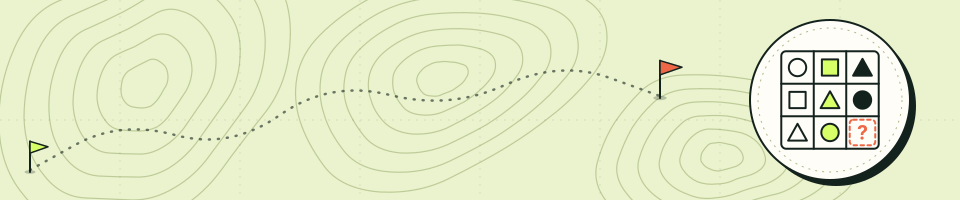
The missing tile
Every row and every column holds each of the three shapes once, so the missing tile takes the shape its row and its column have not used yet. The puzzles get harder as you go, and a guess costs nothing.
Solve 20 puzzles across five types: line combinations, rotations, layered grids, series and odd-one-out. Harder grids combine rules; review each answer with its rule and your accuracy by type.
What this test looks at
combining lines · 4
turning figures · 4
layered grids · 4
figure series · 4
odd one out · 4
Time
12 minutes
Questions
20
Result
score by question type, every answer explained
Figures need to be clearly visible; retakes may include familiar puzzles.
Your answers are kept in this browser for 48 hours so you can continue where you left off; start over to erase them. If you sign in, you can save your result (not your answers). When session replay is on, it can include visible questions, choices and results. Privacy details.
Your progress
A solved example, not scored
The missing tile
Why: each row keeps its shape while the number of shapes grows one, two, three, left to right, so the missing tile is three outlined squares.
Review
You answered every question
See your result now, or go back and change your answers.
Your answers were not sent or stored. Restart, or contact support with error code MTA-LOCAL-1—not your answers.
Practise this type with hints
Practice grids, figure series and odd-one-out puzzles with three hints: where to look, the rule, then the worked solution. Practice questions — they don’t affect your test result.
5 questions · untimed · 3 hints each · free, no sign-up
Learn the rules, try a puzzle and use a hint when you need one.
Your answers are never sent to us. We count how many hints are opened, never which answer you chose; on test pages, masked session replay may record your clicks (privacy section 2.6).
Five puzzles, solved step by step
Five fixed puzzles, grids and a figure series, each built on a different rule. Read one feature at a time before you open the first hint: the shape, its shading, how many there are, which way it points, and which lines two tiles share.
Example 1: Matrix puzzle
Which option completes the grid?
A: 1 outlined triangle
B: 1 filled triangle
C: 1 filled circle
D: 1 outlined circle
Hint 1: where to look
Look at the first row alone and list what differs across its tiles. Then see if row two differs the same way.
Hint 2: the rule
Treat shape and shading separately. The shape is fixed in a row, and the shading grows by one level each column. Row 1: outlined to half-filled.
Hint 3: worked solution
Start with the bottom row's shape, which stays fixed along the row.
Tile 1 is 1 outlined circle; tile 2 is 1 half-filled circle.
The shading moves on again, as it did in the rows above.
The missing tile is 1 filled circle.
Now find it among the options.
Answer: why each option fits or fails
Answer: C. 1 filled circle.
AOption A breaks two features: its shape comes from the tiles above the gap, not its own row, and its shading repeats the bottom row.
BOption B has triangle as its shape, taken from the tiles above the gap, not from its own row.
C✓ AnswerOption C is correct: 1 filled circle.
DOption D uses outlined for its shading, a value the bottom row already holds.
Example 2: Matrix puzzle
Which option completes the grid?
A: arcs at the bottom right, bottom left and top left; spokes at the top and right
B: arcs at the bottom right and top left; spokes at the top and right
C: arcs at the bottom right and top left; spokes at the top, right and bottom
D: arcs at the bottom right, bottom left and top left; spokes at the top, right and bottom
Hint 1: where to look
Cover tile 3 in row 1. Study the lines in tiles 1 and 2, then uncover tile 3 and see what stayed.
Hint 2: the rule
Ask of each element: is it in both tiles? Then it cancels; if it is in just one tile, it stays. Row 1 keeps arcs at the bottom right, bottom left and top left and spokes at the top and bottom. Your turn on the bottom row.
Hint 3: worked solution
Apply the rule to the bottom row.
Tile 1 has the top-left arc and spokes at the top and right.
Tile 2 has the bottom-right arc and the bottom spoke.
Elements in both tiles cancel.
Elements in exactly one tile stay.
Tile 3 therefore shows arcs at the bottom right and top left and spokes at the top, right and bottom.
Now find it among the options.
Answer: why each option fits or fails
Answer: C. Arcs at the bottom right and top left; spokes at the top, right and bottom.
AOption A has two faults: its arcs are off (bottom left extra), and its spokes take tile 2's off tile 1 (bottom missing).
BOption B takes tile 2's spokes off tile 1: it drops the one at the bottom (only in tile 2).
C✓ AnswerThe correct one is option C: arcs at the bottom right and top left and spokes at the top, right and bottom.
DOption D gets the arcs wrong: it adds the one at the bottom left (in neither tile).
Example 3: Matrix puzzle
Which option completes the grid?
A: 1 outlined square
B: 3 outlined diamonds
C: 1 outlined diamond
D: 3 outlined squares
Hint 1: where to look
Compare the first and second tiles in one row. Count what is in each and say what changed.
Hint 2: the rule
Each tile has one more figure than the tile before it. Row 1 counts 1, 2, 3; the bottom row takes the same steps.
Hint 3: worked solution
Bottom row: tile 1 is 1 outlined diamond, tile 2 is 2 outlined diamonds.
The number goes up by one again, while the shape and shading stay the same.
So tile 3 is 3 outlined diamonds.
Now find it among the options.
Answer: why each option fits or fails
Answer: B. 3 outlined diamonds.
AOption A breaks two features: its shape comes from the tiles above the gap, not its own row, and its number of figures repeats the bottom row.
B✓ AnswerOption B is correct: 3 outlined diamonds.
COption C uses 1 for its number of figures, a value the bottom row already holds.
DOption D gets its shape, square, from the tiles above the gap instead of from its own row.
Example 4: Matrix puzzle
Which option completes the grid?
A: a flag with its top pointing right
B: an upright flag
C: an upside-down flag
D: a flag with its top pointing left
Hint 1: where to look
In row 1, describe how the flag moves from tile 1 to 2, then from tile 2 to 3. Compare the two.
Hint 2: the rule
Each step, the flag turns anticlockwise by a quarter. Row 1: from top pointing left to upside down. Now take one more step from tile 2 of the bottom row.
Hint 3: worked solution
Start at the bottom row.
Tile 1: upright.
Tile 2: top pointing left.
Repeat the same turn, anticlockwise, from tile 2.
Tile 3 would be an upside-down flag.
Now find it among the options.
Answer: why each option fits or fails
Answer: C. An upside-down flag.
AOption A turns the flag a half turn from tile 2, a quarter turn too far, so its top points right.
BOption B turns the flag clockwise from tile 2, against the rule, so its top points up.
C✓ AnswerOption C is correct: an upside-down flag.
DOption D stops the flag where tile 2 has it, top pointing left; it still has a step to take.
Example 5: Figure series
Which tile comes next?
A: 2 half-filled triangles
B: 1 half-filled triangle
C: 2 filled triangles
D: 1 filled triangle
E: 3 filled triangles
Hint 1: where to look
Compare the five tiles feature by feature: shape, shading and number. Note which never change.
Hint 2: the rule
Only the number of figures changes. It starts 1, 2, 3 and follows a cycle of three. Carry the cycle on to the gap.
Hint 3: worked solution
Shape and shading never change, so only the number of figures matters.
The cycle has three steps: 1, 2, 3.
Tile 5 shows 2 figures, and after 2 comes 3, which gives 3 filled triangles.
Now find it among the options.
Answer: why each option fits or fails
Answer: E. 3 filled triangles.
AOption A breaks two features: its shading is half-filled, which no tile in the row has, and its number of figures stays at 2.
BOption B is wrong on two features: its shading is half-filled, which no tile in the row has, and its number of figures jumps to 1, the wrong step.
COption C stays on 2 for the number of figures, so the cycle seems to stop.
DOption D shows 1 for the number of figures. That is in the cycle, but it is not the next step.
E✓ AnswerThe correct one is option E: 3 filled triangles.
How the hints work
On a grid, the first hint names the features to compare along a row without saying how they change. The second names the rule, for example lines that cancel when two tiles are laid on top of each other, and shows it on the top row. The third walks the bottom row to a description of the missing tile, in words rather than by letter. A figure series is read the same way from tile to tile instead of along a row. In an odd-one-out puzzle the hints first find what most of the figures share, then the one that breaks it. The answer comes last and says why each option fits or breaks.
The test above is a fixed set of twenty puzzles with a result at the end. The practice builds new puzzles each time, gives hints while you work, and ends with counts of what you solved on your own or with help, never a score.
Which rules do the practice grids use?
Shading and counting steps, one of each shape per row, shapes that turn, tiles that combine, and lines that cancel or that two tiles share. Grids with one changing feature come first, then harder rules as you get them right.
Can I practise without the clock?
Yes. Both sets with hints have no clock. The timed set of 10 gives you 43 seconds a puzzle, with no hints until the end.
Do practice puzzles appear in the test?
No. Practice puzzles are built new each time and the test's twenty are fixed; none of the worked examples on this page is a test question either.
Use the result
What this test adds
See which changes you spotted in each type of puzzle, and use the worked answers to understand the ones you missed.
A small next step
For a missed grid, describe what changes along each row and each column before looking at the options again.
Questions people ask
What will my result show?
Your score, results for each kind of puzzle and a worked explanation for every answer.
What do the five kinds of puzzle test?
There are five types, four puzzles each: line combinations, rotations, layered grids, series and odd-one-out. Each review explains which option fits the grid’s rules.
Is there a time limit?
No. Take time to inspect each grid; results show which rules you found, not how quickly.
Allow Microsoft Clarity cookies for optional session replay? It records clicks and visible page content on eligible general pages and selected puzzle and skill tests, including questions, choices and results. Typed text and account controls stay masked. Personality, health, children's and private pages are excluded. How we use it